My therapist gave me an assignment in 2019. He told me to make a list. I thought it was too simple to matter. I was wrong.
The Night I Made the List
It was 2018. I had moved out of his place — not cleanly, not on good terms, but out. Forced out by fear. I had nowhere to go. I found a house, explained to the owner that I was in a DV situation, and she let me move in immediately.
Several weeks passed. I was still so confused that I agreed to meet up with him. I thought the dust had settled. I thought he would be thinking clearly.
He wasn't.
He showed up and pulled out his phone. He wanted to show me a photo — of her. The 22-year-old bartender he had been calling his “dog sitter”. He pulled it up and held it out to me. Not by accident. On purpose. He wanted me to see her face.
I drove around in shock for about a half hour after he tried to get into my car.
One minute he was trying to break the driver’s side window to get to me in the parking lot, and a half hour later, he was in my house. He broke in. I returned home, scared and shaken up. He came toward me, and I don’t know how, but I managed to dial 911, shaking like a leaf.
What happened after that was a kind of terror I had never felt before. He fled on foot when I called the police, leaving his truck parked in front of my house like a warning. The police told me to go somewhere else and wait it out. They told me to file a restraining order.
I didn't.
At the advice of my manager at the insurance company, I chose not to file. She told me I could ruin his life by filing an order of protection. I respected her. I listened. It would end up being a very big mistake.
It was less than a year later that I ended up in rehab. Even though we — and I am ashamed to say this — had gotten back together. Even though he was ruining my life, I took him back. It was in rehab that my therapist asked me to make an inventory list of the pros and cons of being in this relationship. I truly didn't see the point.
He was right. I was wrong. There is always a point.
Why I Was There in the First Place
I want to be clear about why I went to treatment in 2019, because I think it matters. I was not only there for the drinking. I was there because I was trying to leave this relationship — and the stress of it had created a mental health crisis I could not manage on my own anymore. It was a dual diagnosis clinic, one that treated both substance use and the mental health conditions that so often travel alongside it. I was not just treating one thing. I was treating everything the relationship had done to me.
The cheating, the emotional and physical abuse, the gaslighting, the manipulation — they had all taken their toll. I was self-medicating nightly. My nightly concoction: a bottle of wine, 20 mg of THC, Klonopin, and Ambien. Every night, for about three years. I was so unhappy that all I wanted to do was sleep. What I did not know at the time was that the combination could have killed me in my sleep.
I had been trying to leave for years. Not months. Years. I would get close — I would feel the pull of the exit, that terrifying and clarifying moment when you can almost see the door — and then something would happen. A conversation. A moment of tenderness. A crisis that needed me. And I would stay. I always stayed.
The bond is not a metaphor. It is a mechanism. It pulls you back with the same force that a current pulls a swimmer, and you can know exactly what is happening and still not be able to fight it.
The Assignment
When I was in treatment, my therapist gave me an assignment I had been refusing for three weeks: make a pros and cons list. Not a mental one. Not the kind you run through in your head at two in the morning when you cannot sleep. A written one. Pen on paper. Every item accounted for.
I remember thinking: I already know what is on the list. I already know what the answer is. What is the point of writing it down?
He told me to do it anyway.
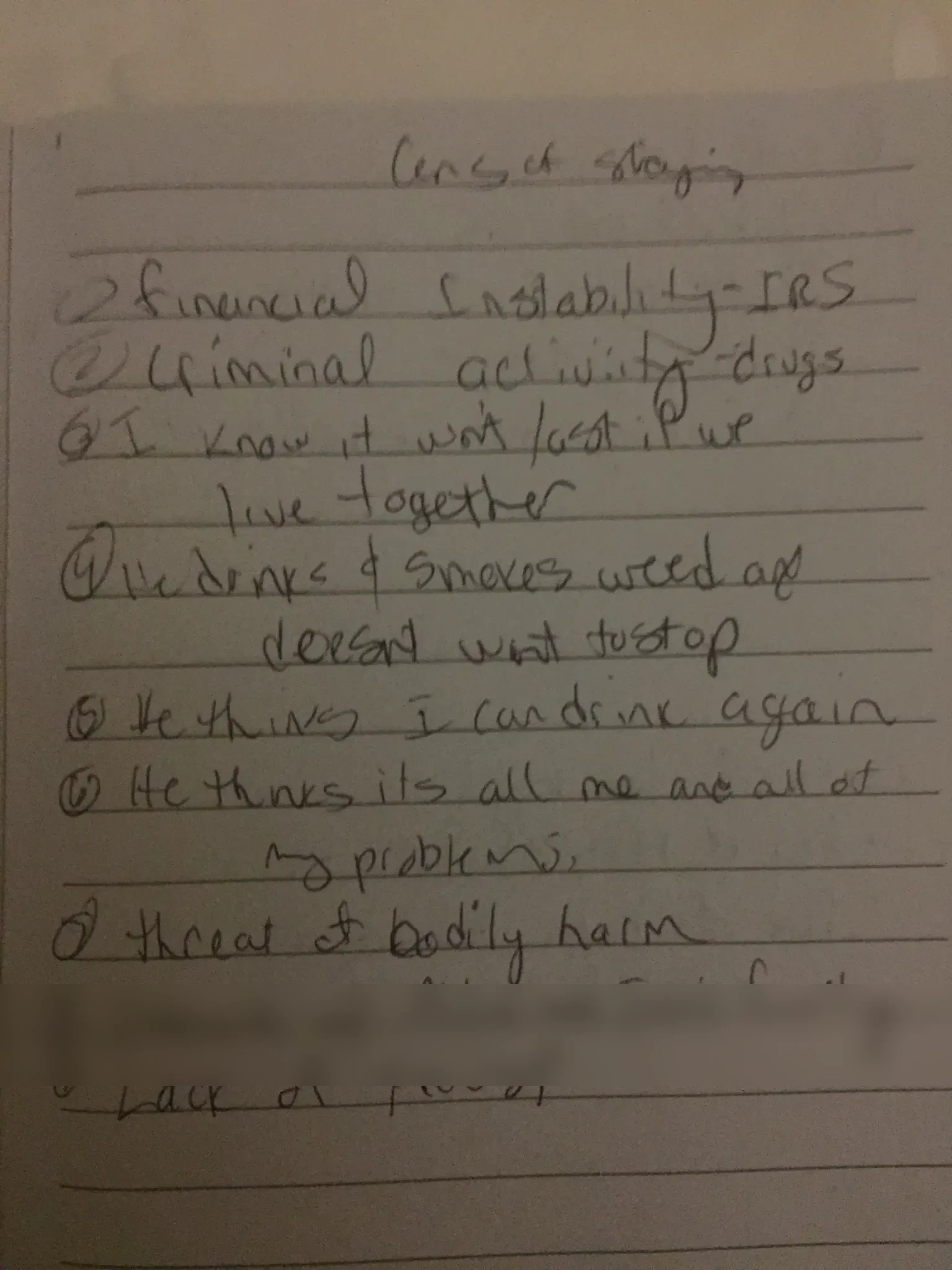
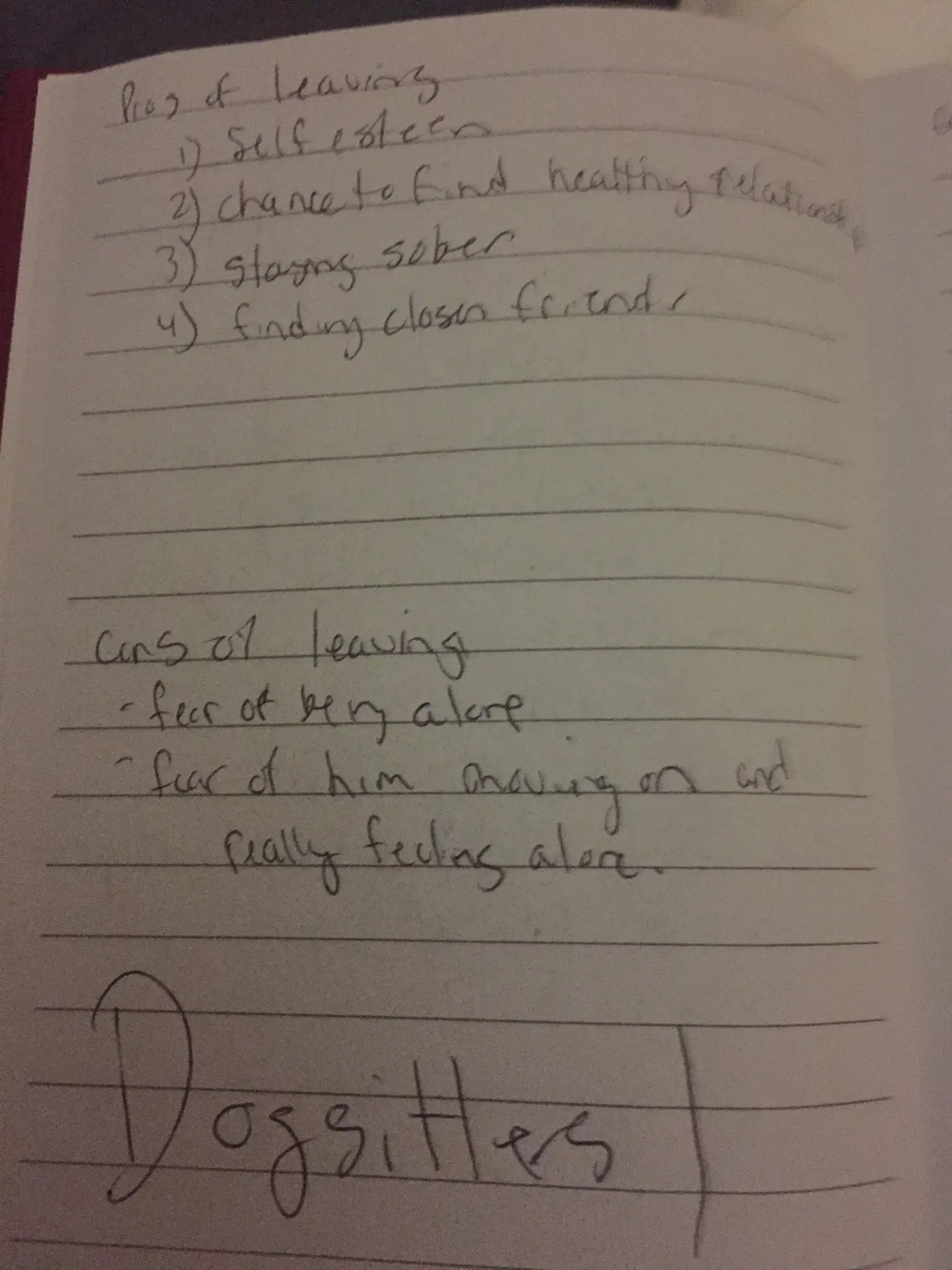
My hands were shaking so hard when I was writing this, that I could barely read my own writing.
I wrote the list. I ended things with him over a text, while I was three weeks into rehab. I sent him a photo of the list so he would understand why. I would not see him again for months. I moved far into the mountains in Big Bear.
"I was three weeks into rehab when I finally wrote the list. I did not know then that it would change everything."
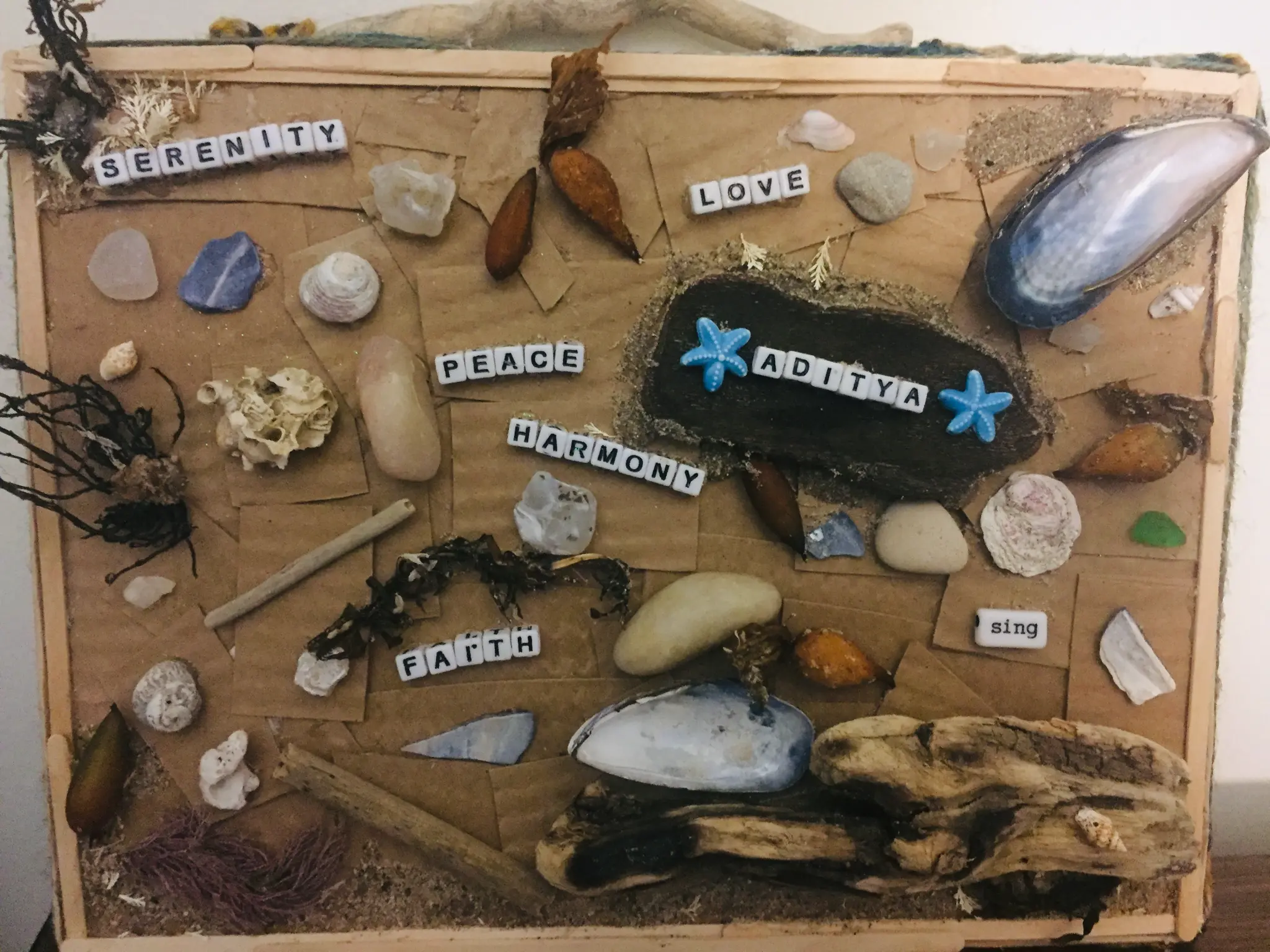
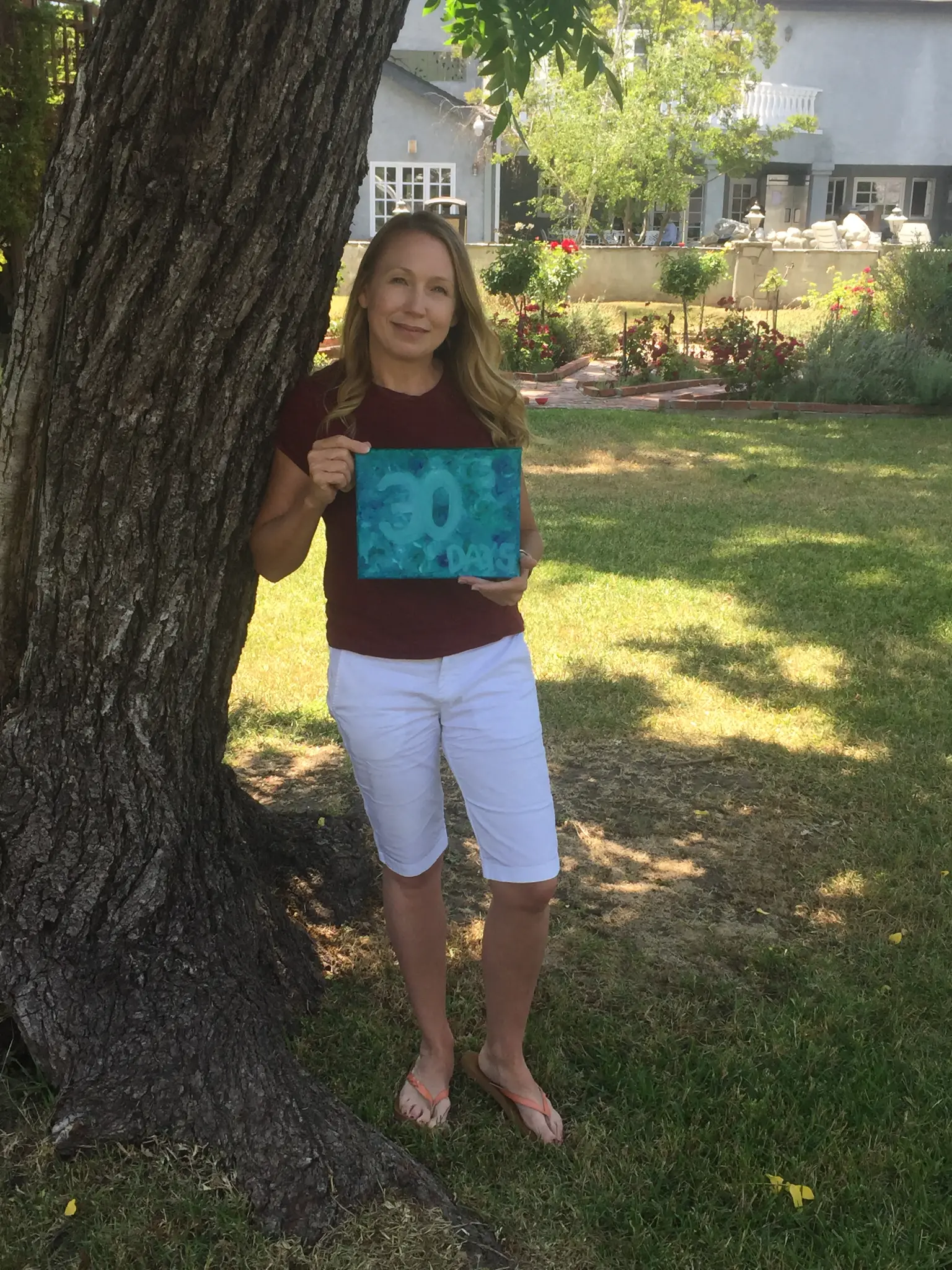
The art I made in rehab. Things I collected on our weekly beach trips. Naming one of our fellow friends who did not win the fight — Aditya. May he RIP.
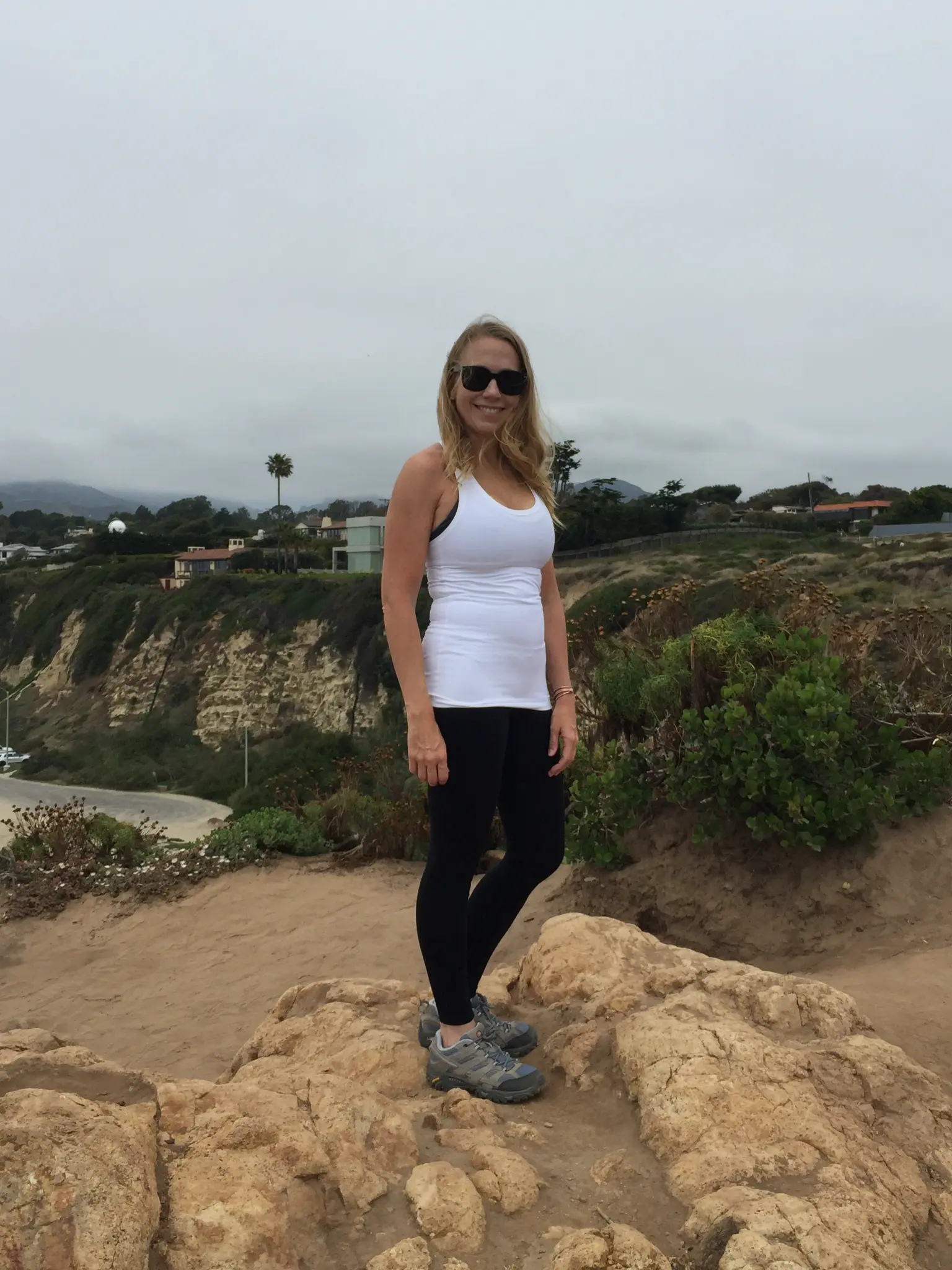
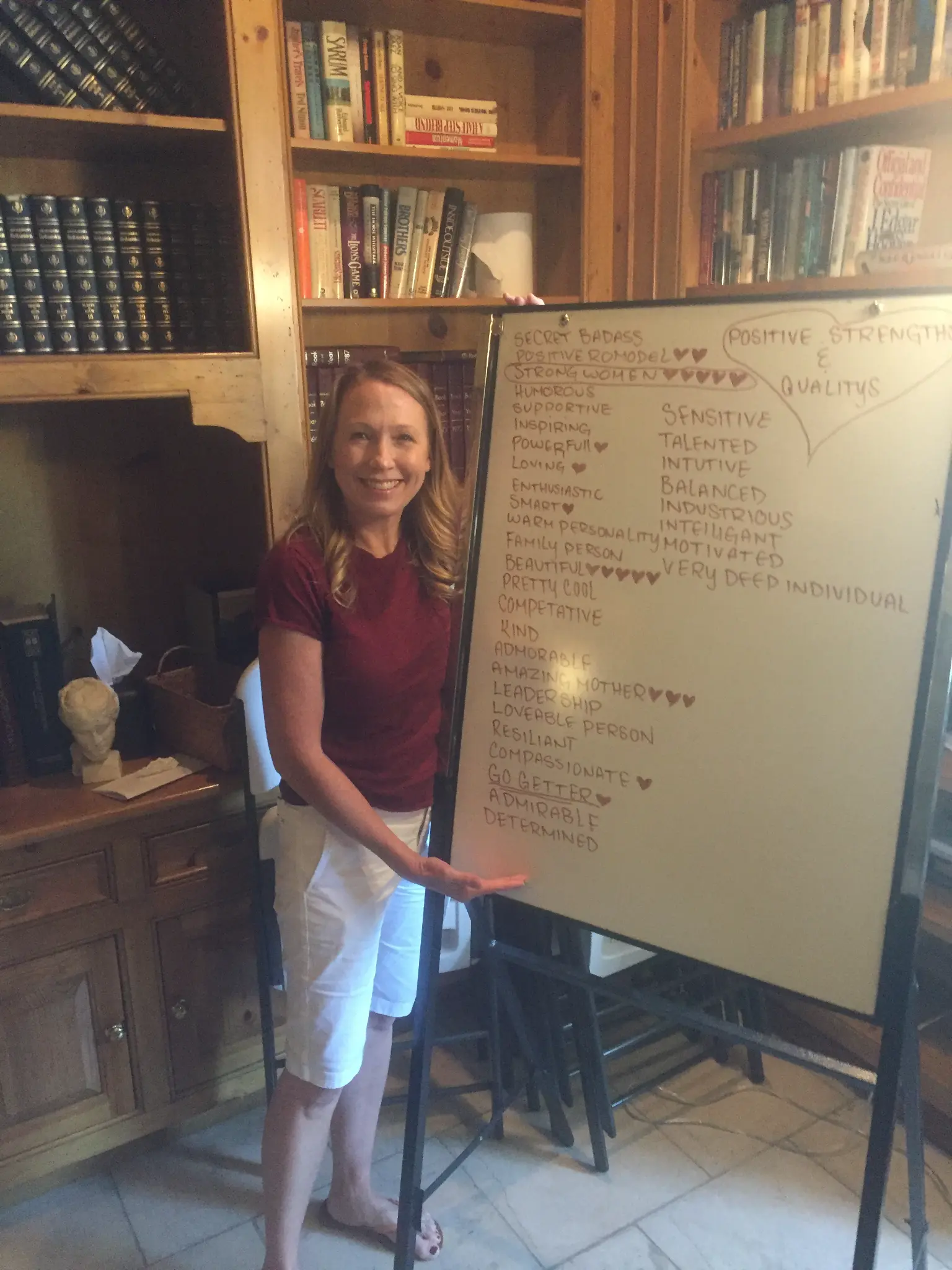
Photos taken while I was in treatment
What Writing Does That Thinking Cannot
There is a reason therapists ask you to write things down. It is not busywork. It is not a formality. There is actual science behind what happens when you move a thought from your head onto a page.
When you think something, it lives in a part of your brain that is also responsible for emotion, memory, and survival instinct. Thoughts in that space are slippery. They bend. They negotiate with themselves. They are subject to the same distortions that trauma creates — the minimizing, the rationalizing, the way love rewrites history in real time.
When you write something down, you engage a different part of your brain entirely. The act of forming letters, of choosing words, of committing a thought to a surface that will hold it — that is an act of encoding. You are telling your nervous system: this is real. This happened. This is true.
Writing externalizes the thought. It takes it out of the fog of feeling and puts it somewhere you can see it. And once you can see it — once it is sitting there on the page, in your own handwriting, in your own words — it becomes much harder to un-know.
That is the point. That is exactly the point.
The List
I am making the list again.
I have been in this relationship for years. On and off, back and forth, leaving and returning — the cycle that trauma bonding creates and that I have lived inside of for longer than I care to admit. I know the cycle. I have named it. I have read about it. I have talked about it in therapy. And I have still gone back, because knowing the name of something does not automatically break its hold on you.
But I am making the list again. And this time I am going to write it here, where I cannot fold it up and put it in a drawer.
The Silence Where an Apology Should Be
We had a conversation recently. A speeding ticket and a parking ticket one day apart — his, not mine — became the entry point for something larger. I tried to talk about it. I tried to talk about the pattern, about the accumulation, about what it means to keep watching someone make the same choices and expect a different result.
He was silent because he is avoidant. It is his most reliable skill — using DARVO like a professional, the ability to redirect a conversation away from himself so smoothly that you sometimes do not notice it has happened until you are somehow defending yourself when you were the one who raised the concern.
There was no comment on the infidelity or the abuse. There never is. It sits in the room like furniture neither of us acknowledges — present, immovable, taking up space. I have learned not to expect an apology. An apology would require him to hold the weight of what he did, and he has never been willing to do that. Deflection is easier. Deflection keeps the weight on me.
Just the familiar architecture of the conversation — the pivot, the reframe, the way the subject changes and I am left holding a question that was never answered.
I did not get through. I never get through. And I am starting to understand that getting through is not the goal anymore. The goal is something else entirely.
What the List Does to You
When I made the list in 2019, I went back. I want to be honest about that. I made the list, I looked at it, I understood what it meant — and I went back anyway. It may have taken several months, but I succumbed.
Within weeks I would discover he was cheating on me again. He flatly denied it, but I spoke with her. She was real.
But something had shifted. I went back with a clearer understanding of my own boundaries. I went back knowing, in a way I had not fully known before, what I was accepting and what I was not. The list did not save me from the relationship. But it saved me from the illusion that I did not know what the relationship was.
That is not nothing. That is, in fact, everything.
Because the cruelest part of a trauma bond is not the pain — it is the confusion. It is the way love and fear and history and habit all tangle together until you genuinely cannot tell what you feel or what is real or whether you are the problem. The list cuts through that. It does not care about the tangle. It just asks: what is true? What is actually, factually, undeniably true?
And when you write it down, you have to answer.
The Inventory
Taking inventory is a concept I first encountered in recovery. Step four. A searching and fearless moral inventory of ourselves. The idea is that you cannot move forward carrying things you have not looked at. You have to open the boxes. You have to see what is in them.
I have been applying that same principle to myself — and to this relationship.
This website is, in its own way, my moral inventory. But so is the list. An inventory of the relationship itself. What is here? What has been here? What am I carrying, and what is it costing me?
The list is the inventory. And the inventory is not cruel — it is kind. It is the kindest thing you can do for yourself when you are in the middle of something that has been slowly convincing you that what you see is not what is there.
Write it down. All of it. The debt and the drinking and the deflection and the silence where an apology should be. Write down the one pro and the twelve cons. Write it in your own handwriting, on actual paper, and then read it back to yourself out loud.
See what happens.
Still Here, But Different
I am still here. I have not left yet. I want to be honest about that too, because I think the most useful thing I can do in this series is tell the truth about how long things actually take — not the version where the insight arrives and the action follows immediately, but the real version, where you know something for a long time before you are able to act on it.
The knowing and the leaving are not the same moment. They can be years apart.
But the list is a beginning. The list is the moment you stop negotiating with yourself about what is real. And once you have made it — once you have written it down and read it back and sat with it — something in you changes. Not all at once. Not dramatically. But something shifts, and it does not fully shift back.
I made the list in 2019. I am making it again now.
This time, I think I am closer to the door.
The truth does not change when you write it. But something in you does.
If you are in a relationship where the cons fill the page and the pros amount to a roof over your head — I am not here to tell you what to do. I know how complicated it is. I know how the bond works and how the leaving feels impossible even when you know it is necessary.
But I will tell you this: write it down. All of it. Let the page hold what your mind keeps softening.
Resources
The National Domestic Violence Hotline — 1-800-799-7233 | support for those in abusive relationships
loveisrespect.org — trauma bonding, healthy relationships, and support resources
NAMI — National Alliance on Mental Illness: mental health resources and peer support
Psychology Today — find a therapist specializing in trauma and relationships
DARVO — Dr. Jennifer Freyd, PhD (the psychologist who coined the term)
SAMHSA National Helpline: 1-800-662-4357 | Free, confidential, 24/7
Journaling Prompt
Make the list. Not in your head — on paper. Two columns. Everything that is working, everything that is not. Read it back to yourself out loud when you are done. Then ask yourself: if a friend showed me this list about her relationship, what would I tell her?
Continue the Series
The story continues in Read Part Forty-Seven →
Where I Got Help
I went to treatment at Harmony Place in Woodland Hills, California. It is a dual-diagnosis residential treatment center. If you are in a situation like mine, or you know someone who is, it is worth knowing that places like this exist.
Join the Conversation
Be the first to share your thoughts