If I Could Help One Person — Part Thirty-Six · New
It Listens and It Does Not Judge
Mental Health, Mania, and the Strange Gift of Creativity
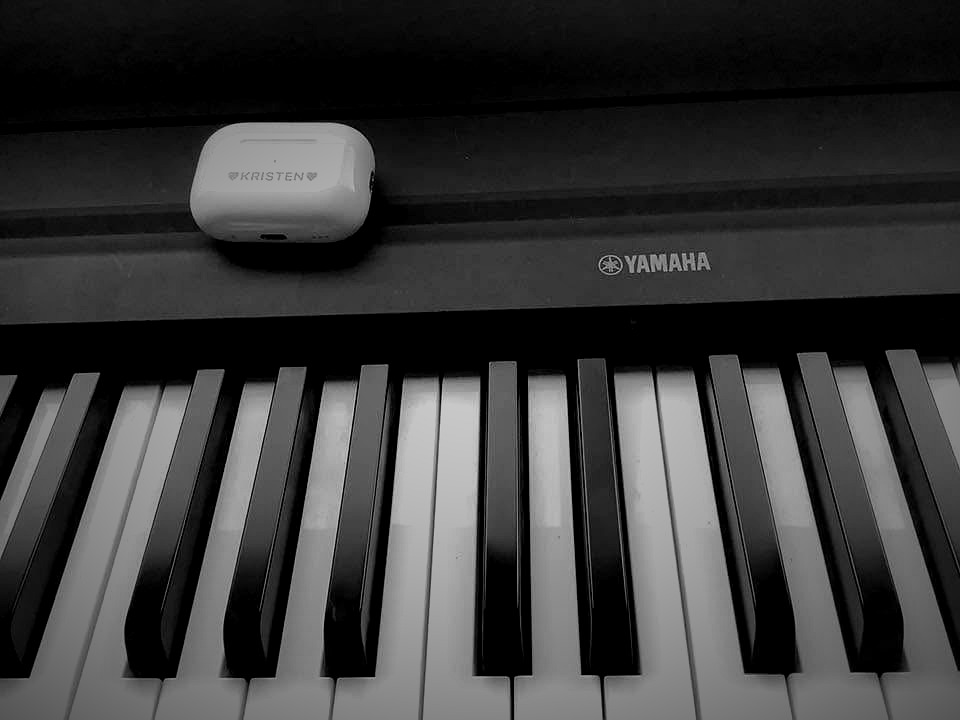
🎹 Listen to the raw recordings
Listen →If I Could Help One Person — Series
View All →There was no music in my childhood home. Not really.
My dad would put on the Doobie Brothers sometimes, in the car, on long drives — windows down, the kind of music that felt like it belonged to someone else's life. Something looser. Something freer. My dad was a heavy smoker, and I can still feel it — the cigarette smoke drifting back through the open windows, mixing with the summer air, part of the whole sensory memory of those drives.
I wanted to make that feeling. I didn't know how. I just knew I needed to.
I begged my parents for a piano.
They obliged — which, looking back, was no small thing. A piano is not a casual purchase. It is a commitment. It takes up a room. And so there it was, in our house, this enormous, patient, wooden thing, waiting for me to become something.
I endured five years of weekly lessons. I say endured because that is the honest word. My teacher was kind — Mrs. Platner, a warm woman in my hometown who kept a big German Shepherd that lay under the piano bench during every lesson. I adored her. I was allergic to her dog. By the time we pulled out of her driveway, my eyes were swollen shut and my nose was running like a faucet. Miserable, every single time, and I never once asked to stop going. The scales were not kind either. I practiced because I was supposed to, not because I was on fire. And eventually, the way these things go, I gave it up. I walked away from the piano the way you walk away from a version of yourself you were never quite sure you believed in.
"The muscle memory of longing. The way your hands know things your brain has forgotten."
Years passed. Life happened — the kind of life that accumulates quietly and then all at once.
Then my mom's friend offered me a free piano.
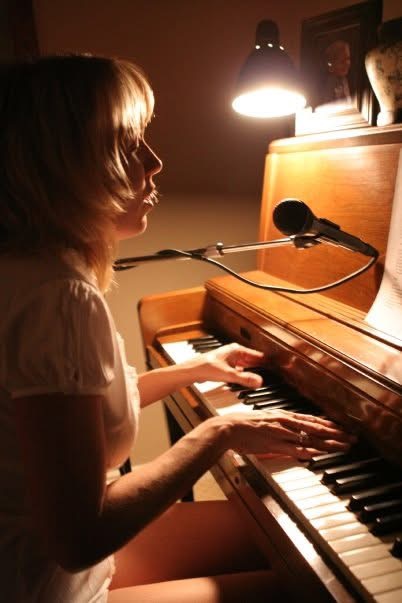
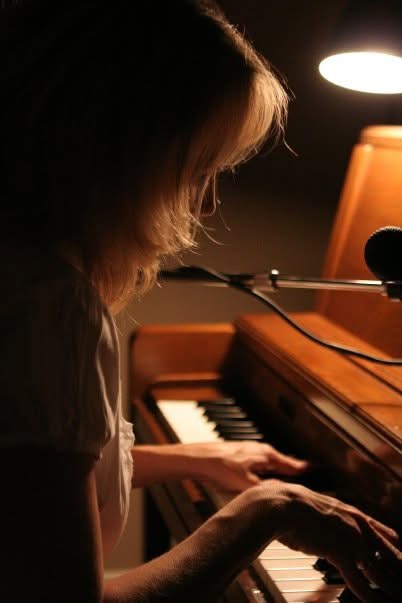
I don't know why I said yes. I wasn't looking for it. But something in me recognized the offer as something more than furniture. I took it. I moved it into my space. I sat down at the keys.
And slowly — slowly — something came back.
Not the scales. Not the lessons. Something older than that. The muscle memory of longing. The way your hands know things your brain has forgotten. I started playing again, quietly, privately, reclaiming a skill I had abandoned so long ago it felt like someone else's.
Several years passed like that. Gentle. Incremental. The piano was just there, the way a good thing is just there — not dramatic, not urgent, just present.
And then I hit a very low low.
I want to be careful here, because "low" is a word that gets used casually and I don't mean it casually. I mean the kind of low that has weight. The kind that sits on your chest at three in the morning and tells you things that aren't true but feel truer than anything. The kind that comes with a diagnosis — bipolar disorder — that I had been carrying without a name for most of my adult life.
In that low, the piano became everything.
I didn't plan it. I didn't sit down one day and decide to make art out of my pain. It wasn't that intentional or that clean. It was more like — I had nowhere else to put it. The feelings were too large for conversation. Too tangled for therapy alone. Too raw to hand to another person and say here, hold this.
So I handed it to the piano.
I wrote. I recorded. I made an album — my deepest thoughts, everything I had been through, spewed out onto a keyboard. Every relationship that had fractured. Every version of myself I had lost. Every morning I had woken up and not known which Kristen would be showing up that day.
It poured out of me. And I let it.
The Extremes
Here is what I have come to understand about myself, and what I suspect is true for more of us than we admit:
My most creative periods have always lived at the extremes.
The lowest lows. The highest highs. The manic stretches where I felt electric and untouchable and like I could write a song and repaint the living room and start a business all before noon. The depressive valleys where the only language that made sense was minor chords and silence.
This is not a coincidence. And it is not unique to me.
There is a long, complicated, and still-unresolved conversation in mental health research about the relationship between mood disorders — particularly bipolar disorder — and creativity. The names are everywhere once you start looking: Sylvia Plath. Virginia Woolf. Robert Schumann, who composed furiously during manic episodes and could barely lift a pen during depressive ones. Carrie Fisher, who turned her diagnosis into art and advocacy and kept showing up anyway.
The connection is real. It is also dangerous to romanticize.
Because here is the other side of the story: I also have years I barely remember. Stretches where the mania wasn't electric — it was destructive. Where the creativity wasn't a gift — it was a symptom. Where I made decisions I am still untangling. Where the piano sat untouched not because I was in a low, but because I was in a chaos that looked like energy from the outside and felt like drowning from the inside.
Mental illness is not a muse. It is not a prerequisite for making something beautiful. I want to be clear about that.
But for those of us who live with it — who have learned to recognize our own patterns, our own seasons, our own warning signs — creativity can become a kind of translation. A way of making meaning out of something that otherwise has none.
"Mental illness is not a muse. It is not a prerequisite for making something beautiful."
The Album
The album I recorded during that low is not polished. It is not produced. It is not the kind of thing I would hand to a stranger and say here is my best work.
But it is the most honest thing I have ever made.
Every track is a moment I survived. Every chord progression is a feeling I couldn't say out loud. Every lyric is a version of the truth I was only brave enough to speak because I was speaking it to a piano, alone, in a room where no one could see me fall apart.
That is what creativity does, at its best. It gives the unspeakable a container. It takes the enormous, formless weight of a mental health struggle and gives it shape — a song, a webpage, a craft, a garden, a meal made with intention. Something you can point to and say: I was here. I felt this. I made something anyway.
What Is Actually Happening in the Brain
There is a reason this is not just a metaphor. The relationship between mental health, substance use, and creativity is neurological — and understanding it changed the way I think about my own story.
Dopamine is the brain's primary reward chemical. It is released when we experience something pleasurable — food, connection, music, sex, alcohol. It is also the chemical most directly implicated in both bipolar disorder and substance use disorder. In a manic episode, dopamine floods the system. The world feels electric. Ideas come faster than you can catch them. The inhibitions that normally slow you down — the inner critic, the fear of judgment, the voice that says this is too much, pull back — go quiet. What's left is pure creative signal.
Alcohol and many other substances work through a similar pathway. They suppress the prefrontal cortex — the part of the brain responsible for judgment, self-monitoring, and executive function. For someone who has spent their whole life being told they are too much, too loud, too raw, too emotional — the silencing of that internal regulator can feel like freedom. Like finally being allowed to say the thing.
This is why so many artists have used substances to create. Not because they were weak or self-destructive, but because the substances were doing something real — lowering the threshold between feeling and expression. Giving access to a creative state that felt otherwise unreachable.
The problem — and it is a significant problem — is that the brain adapts. Over time, it requires more of the substance to produce the same effect. The prefrontal cortex, chronically suppressed, begins to lose function. The dopamine system, chronically flooded, downregulates its own receptors. What started as a key to the creative door becomes the thing that locks it.
And then you get sober. And you stand in front of the piano. And the silence is enormous.
"And then you get sober. And you stand in front of the piano. And the silence is enormous."
The Grief of Creating Sober
Nobody tells you about this part.
They tell you sobriety will give you your life back. And it does — in so many ways, it does. But for those of us who used substances as a creative accelerant, getting sober can feel like losing a collaborator. The version of you who wrote at 2 a.m. with a glass of wine and no filter, who played piano until the neighbors complained — and then bought their patience back with jello shots when the jam sessions spilled into the weekend — who said the unsayable thing in the song because the alcohol made the fear small enough to step over — that version goes quiet.
And you grieve her. Even knowing she was hurting you. Even knowing the cost. You grieve her because she made things. Because she was brave in a way that felt impossible sober. Because the blank page in early recovery is one of the loneliest places I have ever stood.
What I have learned — slowly, imperfectly, over years — is that the creativity does not disappear. It goes underground. It waits. The prefrontal cortex, given time and rest and stability, begins to heal. The dopamine system recalibrates. The inner critic, which the substances were suppressing, has to be negotiated with rather than chemically silenced — which is harder, and slower, and ultimately more honest.
The art you make sober is different. It is not worse. It is more deliberate. More earned. It has a different texture — less feverish, more considered. And sometimes, in the middle of a quiet afternoon with nothing but the piano and the light coming through the window, it is more beautiful than anything I made in the dark.
Britney, and What Her Story Is Really About
I want to talk about Britney Spears. Not the tabloid version. Not the shaved head or the umbrella or the years of late-night punchlines. The real version.
Britney Spears is the most visible example in modern history of what happens when a woman's mental health becomes inconvenient to the people around her. She was not given space to fall apart and come back. She was not offered the quiet dignity of a breakdown followed by recovery. Instead, she was stripped of her autonomy — her finances, her medical decisions, her reproductive choices, her career — under a conservatorship that lasted thirteen years and was framed as protection while functioning as control.
And through all of it, she kept performing. She kept creating. Not always because she wanted to, but because the system that was supposed to protect her had decided that her value was in her output.
This is the dark side of the creativity-and-mental-illness conversation that almost never gets spoken aloud: sometimes the art is not a gift. Sometimes it is a demand placed on someone who is barely surviving. The world is very good at celebrating the art while ignoring the cost to the person making it.
Britney's story matters to me — to all of us — because it is an extreme version of something many women with mental illness experience in quieter, less visible ways. The pressure to keep functioning. To keep producing. To keep being useful and palatable and not too much trouble, even when you are drowning. The message, delivered in a thousand different ways, that your worth is conditional on your output.
She is not alone in this story, only the most famous. Carole King wrote Tapestry in the aftermath of a marriage that broke her open. Alanis Morissette made Jagged Little Pill from rage and heartbreak and the particular fury of a young woman who had been told to be smaller. Amy Winehouse — whose story ended too soon and too painfully — made some of the most emotionally precise music of her generation while fighting a battle that the industry watched and monetized and did almost nothing to help.
The pattern is not subtle. Women in pain make extraordinary art. And then the world consumes the art and asks why they couldn't hold it together.
I think about this when I sit at my piano. I think about the album I recorded in my lowest low and the fact that I made it for myself — not for an audience, not for a label, not for anyone who needed me to be productive. I made it because I needed somewhere to put the feeling. That distinction — creating for yourself versus creating for consumption — may be the most important one there is.
Your creativity is not a resource to be extracted. It is a language you speak to yourself first.
"Women in pain make extraordinary art. And then the world consumes the art and asks why they couldn't hold it together."
Resources
I am not in that low anymore.
I still play. Not every day, not with the urgency of that season, but I play. And when I sit down at the keys now, I feel something I didn't feel during those five years of childhood lessons — I feel like it belongs to me. Like I earned it. Like the piano and I have been through something together and come out the other side still speaking the same language.
If you are in a low right now, I am not going to tell you to make art. I am not going to tell you that creativity will save you or that your pain is secretly a superpower. That is not what this is.
What I will tell you is this: if there is something — anything — that has ever made you feel like yourself, even a version of yourself you abandoned a long time ago, it might be worth sitting down with it again. Not to perform. Not to produce. Just to remember that you are still in there.
The piano knew I was still in there, even when I didn't.
Listen
Raw Recordings
The album I wrote and recorded during my lowest low. Every track is a moment I survived.
Listen to the raw recordings of Kristen →Journaling Prompt
Think of a creative outlet you had as a child or young adult that you eventually gave up. What did it feel like when you were doing it? What made you stop? And if you were to pick it back up today — not to be good at it, just to be present with it — what might it have to say to you?
Join the Conversation
Be the first to share your thoughts